

How to Prevent RV Damage From Freezing Temperatures in Michigan
Michigan winters don’t give RV owners much grace. Between the hard freezes that hit Montcalm County in November and the unpredictable warm spells that follow in February, the weather here creates a specific kind of punishment for recreational vehicles, one that builds quietly through the season and announces itself, expensively, come spring.
Plumbing repairs after freeze damage can run anywhere from several hundred to several thousand dollars. Roof membrane replacements, delaminated walls from trapped moisture, cracked seals, ruined slide toppers, it adds up fast. And most of it is preventable.
This guide isn’t a generic checklist. It’s a practical look at what actually causes RV freeze damage in Michigan, which risks owners routinely underestimate, and what it actually takes to protect an RV through a full Michigan winter.
Why Michigan Winters Are Especially Hard on RVs
Not every cold climate creates the same risk profile. Michigan winters, particularly in central parts of the state like Montcalm County, combine several conditions that work against stored RVs simultaneously.
Freeze-thaw cycles are one of the main causes of RV wear in Michigan. The state rarely stays at a constant winter temperature. Instead, it moves between deep freezes in January and brief warm-ups where temperatures can rise into the 30s or 40s before dropping again. For RV owners, these repeated swings create ongoing expansion and contraction in seals, fittings, and rubber components, gradually increasing the risk of wear and failure over time.
These conditions are well documented in broader cold-weather safety guidance from the National Weather Service winter safety resources, which highlight how repeated freezing and thawing cycles contribute to long-term structural stress on exposed systems.
Snow load is real. Flat or low-pitch RV roofs aren’t engineered to carry season-long snow accumulation. Wet, heavy snow, the kind Michigan gets repeatedly through winter, stresses roof membranes, skylight seals, and AC units. If that snow melts, refreezes, and sits in pooled water against a seam, leaks develop in places owners don’t discover until summer.
Humidity doesn’t quit. Cold air holds less moisture, but Michigan winters aren’t dry. Condensation accumulates inside stored RVs, especially when outdoor temperatures fluctuate. Slide rooms, underbelly cavities, and cabinetry near exterior walls become a breeding ground for mold and wood deterioration if humidity isn’t controlled.
Cold kills batteries. Lead-acid batteries lose a significant percentage of capacity as temperatures drop, and a fully discharged battery can freeze and crack internally. Lithium systems handle cold better but still need attention. An RV parked outside with a battery that wasn’t properly prepared or maintained through winter can start spring with a dead battery and, in the worst cases, a cracked case.
The Most Expensive RV Freeze Damage You’ll See in Spring
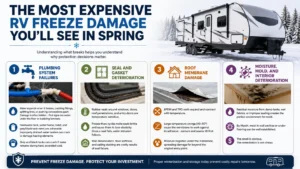
Understanding what breaks helps you understand why protection decisions matter.
Plumbing System Failures
Water expands when it freezes. Inside an RV’s water lines, which are typically smaller-diameter PVC or PEX tubing routed through the underbelly and walls, even a small amount of residual water can crack fittings, split lines, or push connections apart. The damage often isn’t visible externally. The first sign is water under the floor or bubbling laminate when you try to use the system in the spring.
The freshwater tank, water heater, toilet, and grey/black tank vents are all vulnerable. A water heater that isn’t properly drained and winterized can crack the tank or damage the heating element. Gray and black tanks crack less often but aren’t immune to freezing if they retain water volume over a hard, extended cold stretch. The pattern of how freeze damage moves through an RV plumbing system follows a fairly predictable path, and understanding it helps prioritise where to focus your winterisation efforts.
Seal and Gasket Deterioration
Rubber seals around windows, sliding doors, roof penetrations, and entry doors are temperature-sensitive. Repeated freeze-thaw cycles make them brittle and cause them to lose elasticity. Once a seal fails, water intrusion follows, and water intrusion in an RV is one of the most destructive forces there is.
Wall delamination, floor softness, and ceiling staining are all downstream consequences of seal failure that went unnoticed through one winter. By the time you see the staining, the structural damage is often already done.
Roof Membrane Damage
EPDM and TPO roofs expand and contract with temperature. That’s manageable when the movement is gradual. When temperatures swing 40–50 degrees repeatedly across a season, the membrane works against the adhesive holding it to the substrate. Corners and seams are the first to lift. Once moisture gets underneath, it migrates laterally, and the damage spreads far beyond the original entry point.
Moisture, Mold, and Interior Deterioration
An RV stored with residual moisture inside, from a damp holding tank, wet fabric, or improper sealing before storage, creates a slow-motion interior-damage scenario. By the time March arrives, mold colonies in wall cavities or under flooring can be well established. The smell is obvious. The remediation is not cheap.
Common Winter Storage Mistakes Michigan RV Owners Make
Most RV winter damage is preventable. But it usually happens because of a few repeatable mistakes.
Storing water in the system. The single most common source of spring plumbing repairs. Even a small amount of water left in a low point of the water lines is enough to cause damage during a hard freeze. Full winterisation, including blowing lines with compressed air, treating holding tanks, and draining the water heater, is non-negotiable in Michigan.
Relying on a tarp. A tarp strapped over an RV is not protective storage. It can trap moisture underneath, rub against the roof membrane in the wind, and provide no thermal benefit at all. An RV under a tarp in Vestaburg in January is still exposed to every temperature extreme winter delivers.
Assuming outdoor covered parking is “close enough.” Covered outdoor parking protects from direct snow accumulation, which matters, but it doesn’t address temperature, humidity, or freeze-thaw stress. The RV is still experiencing the same external temperature swings as an uncovered unit.
Skipping the battery check. Batteries left fully charged fare much better through cold storage than depleted ones. Lithium batteries should be stored at a partial state of charge. Lead-acid batteries benefit from a maintenance charger or periodic recharging. Either way, ignoring the battery system through winter often means a problematic start to the spring camping season.
Not managing interior humidity. Closing up an RV with damp towels, a full fresh water tank, or moisture-trapping fabrics left inside creates the conditions for mold growth regardless of outdoor temperature. Leaving cabinet doors and closet doors open during storage, using desiccant packs, and removing anything that retains moisture significantly reduce the risk.
Forgetting the tyres. Tires sitting on concrete in cold temperatures lose pressure and develop flat spots from static loads over time. UV exposure continues even in winter. Tire covers and moving the RV slightly every month or two (when feasible) help, but climate-controlled storage removes the UV and temperature extremes that accelerate rubber degradation.
Why Outdoor Storage Creates Long-Term Risk
There’s a cost argument that often drives the decision to store an RV outdoors, either at home or in an outdoor lot. That reasoning makes financial sense until it doesn’t.
Outdoor-stored RVs in Michigan’s climate deal with 5–6 months of repeated thermal stress, moisture exposure, UV radiation on clear winter days, and potential roof load from heavy snow events. Oversized units, Class A coaches, Super C motorhomes, and fifth wheel trailers have more roof surface area, more exterior seams, and more complex plumbing systems. The cumulative damage risk is higher, and the repair costs when damage occurs scale accordingly.
Beyond the mechanical risks, homeowners storing large RVs on private property often run into HOA restrictions or local ordinances that limit long-term outdoor parking of recreational vehicles. What started as a convenient solution becomes a compliance headache.
How Climate-Controlled Indoor Storage Changes the Outcome
The core value of climate-controlled indoor RV storage in Michigan isn’t luxury; it’s physics.
When an RV is stored in a temperature-controlled environment, the freeze-thaw cycle that causes so much cumulative damage simply doesn’t happen. The seals aren’t stressed by repeated contraction and expansion. The plumbing system, if properly winterised before storage, isn’t exposed to extreme cold that tests the limits of that winterisation. The roof membrane isn’t cycling through 40-degree temperature swings multiple times per week.
Humidity-controlled storage goes further. It removes the condensation dynamic that leads to interior moisture accumulation. An RV that spends winter in a stable, controlled environment consistently arrives at spring in better condition than one that spent those same months outside.
For owners of oversized units, Class A motorhomes, Super C coaches, and large fifth wheels, the challenge is finding climate-controlled storage with genuinely high bay clearance. Most traditional self-storage facilities aren’t built for vehicles with 12–13 foot rooflines, which is part of what separates purpose-built RV storage from general self-storage when you’re shopping options. If you’re not sure whether your unit fits a standard bay, working out what size storage unit your RV actually needs is a practical first step before committing to a facility.
Indoor storage also addresses the secondary issues. Rodent intrusion, a significant and often underestimated problem in rural Michigan, is dramatically reduced inside an enclosed facility compared to outdoor storage. Tire degradation slows without the UV exposure and temperature extremes. Battery systems are easier to maintain in a stable environment. The overall picture of the RV emerging from storage in spring is significantly better.
What to Check Before Storing Your RV for Winter

A solid pre-storage checklist reduces the risk of arriving at a damaged unit in spring. The steps below cover the essentials, though if you want to go deeper on any of these, a full walkthrough of how to properly winterize your RV for off-season storage covers each system in more detail.
Fully winterise the water system. Drain all lines, blow them with compressed air, bypass and drain the water heater, add RV antifreeze to P-traps and holding tank drain lines, and flush toilets.
Charge and maintain the battery system. Connect to a quality maintenance charger or store at an appropriate charge level based on battery chemistry.
Clean the roof and inspect all seams. Look for lifted seams, cracked sealant around roof penetrations, and any debris that traps moisture. Address small sealant issues before they become leaks.
Close or seal off vents and openings. Exhaust vents, refrigerator vents, and other exterior openings are rodent entry points. Mesh covers or foam plugs significantly reduce intrusion risk.
Remove food and organic material. Everything in the pantry, refrigerator, and storage bays should come out. Food odours attract rodents. Open refrigerator and freezer doors to prevent mold growth inside them.
Inflate tyres to the upper end of the recommended range. Cold temperatures reduce tyre pressure; starting slightly high compensates for natural pressure loss.
Open all interior cabinet and closet doors. Allows air to circulate inside the unit and prevents moisture pockets from forming in enclosed spaces.
Check the roof vent covers. Many RV roof vents use plastic covers that become brittle in cold weather. Replacements are inexpensive; dealing with water intrusion through a cracked vent cover is not.
Signs Your RV May Already Have Cold-Weather Damage
If your RV spent previous winters outdoors or in uncontrolled storage, it’s worth doing a thorough inspection before assuming everything is fine.
Soft spots in the floor typically indicate water intrusion that has reached the subfloor. Press gently throughout the floor, especially near slide rooms, entry areas, and the bathroom.
Delamination on exterior walls looks like bubbling, rippling, or separation between the exterior skin and the underlying substrate. It’s caused by moisture that penetrated through seam failures.
Musty or earthy smells inside often point to mold or mildew in wall cavities, under flooring, or in the HVAC system. It can develop in a single winter in the right conditions.
Low water pressure or wet spots under the floor after reconnecting the water system can indicate cracked lines from freeze damage.
Visible sealant cracks around windows, vents, or slideouts are a signal that water may have already gotten in during the past season.
Protecting Your Investment Through Michigan Winters
The math on RV protection tends to work in one direction. The cost of indoor RV storage in Michigan is predictable and fixed going into a season. The cost of repairing freeze damage, addressing mold, replacing delaminated walls, or dealing with failed plumbing is unpredictable and can reach multiples of what storage would have cost.
For RV owners throughout Montcalm County, the practical question isn’t whether Michigan winters create a serious risk for outdoor-stored RVs; they do, but whether the right storage solution is actually accessible.
If you’re looking for high-bay climate-controlled indoor storage built specifically for oversized RVs, motorhomes, fifth wheels, and boats, Finish Line RV Boat Storage in Vestaburg is located at 8814 E Howard City-Edmore Rd. The facility is designed for the kind of oversized units that don’t fit in conventional storage and for owners who understand that winter protection is worth doing right.
FAQs
Do I need to fully winterise my RV even if I’m storing it in a climate-controlled facility? Yes. Climate-controlled storage stabilises temperature and significantly reduces freeze risk, but it’s still best practice to winterise your water system before any long-term storage. A controlled environment is a backup, not a substitute for proper preparation.
How cold does it get in Montcalm County, and how does that compare to RV plumbing tolerances?
Montcalm County regularly sees overnight lows below 0°F during January and February. Most RV water system components are not rated for extended exposure to temperatures below 32°F, meaning a proper Michigan winter easily exceeds the risk threshold for unprotected plumbing.
Is covered outdoor storage better than nothing?
It helps with snow load, which matters for the roof. But covered outdoor storage doesn’t address freezing temperatures, freeze-thaw cycling, or humidity, all of which continue to cause damage regardless of whether the RV has a roof over it.
What’s the biggest winter storage mistake RV owners make?
Not fully winterising the plumbing system. Plumbing damage from residual water in the lines is the most common and most expensive type of freeze damage, and it’s entirely preventable with a thorough winterisation before storage.
How early should I start thinking about RV winter storage in Michigan?
Ideally, you want your RV properly stored before the first hard freeze, which in central Michigan can arrive in October. Waiting until November means cutting it close; waiting until December means gambling on when that first damaging cold snap will hit.


