

Indoor Climate-Controlled Boat Storage vs. Shrink Wrap
If you’re comparing indoor storage to shrink wrap right now, you’re probably staring down a fall haul-out deadline with a decision that feels bigger than it should. It shouldn’t be complicated, but it is, because both options work. They just don’t work the same way, and that difference matters more in Central Michigan than it does almost anywhere else in the country.
This guide walks through what each option actually protects against, where each one falls short, what the real cost looks like over several winters instead of one, and how to match the decision to your specific boat and how you use it. No sales pitch just the information you need to make a call you won’t second-guess in April.
Why This Comparison Plays Out Differently in Michigan
Shrink wrap and indoor storage get compared everywhere boats are stored for winter. But the stakes of that comparison shift depending on where you live, and Montcalm County sits in a part of the state where the shift is significant.
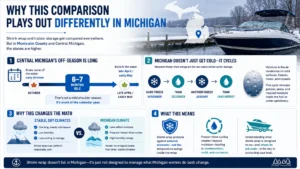
Central Michigan’s off-season isn’t short. Boats here typically come off the water in early October and don’t go back in until late April or early May, a six-to-seven month stretch where the boat sits idle. That’s not a mild shoulder season. It’s most of the calendar year.
During that stretch, the region doesn’t just get cold. It cycles. A hard freeze in November can be followed by a 40-degree thaw in December, then another freeze in January. Each swing forces moisture in the air to condense on cold surfaces, then freeze, then thaw again. This freeze-thaw pattern is the mechanism behind most of the structural and cosmetic damage boat owners discover in spring not a single deep freeze, but repeated cycling that stresses gelcoat, seals, and any trapped moisture inside the hull or under upholstery.
This is the detail that changes the math on shrink wrap versus indoor storage. In a climate with one long, stable cold season and low humidity, a well-installed shrink wrap job can perform reasonably well because there’s less cycling to manage. Michigan doesn’t offer that. The lake-effect moisture pulled off the Great Lakes combines with inland freeze-thaw activity to create conditions that are harder on a wrapped boat than a drier, more stable climate would be.
None of this means shrink wrap fails here. It means the reader needs to understand what shrink wrap is actually designed to do and where its job ends.
What Shrink Wrap Actually Protects Against
Shrink wrap is a physical barrier. It’s a heat-sealed plastic membrane pulled tight over a support frame, and its job is to keep external elements off the boat: rain, snow load, direct UV exposure, and windblown debris. Done correctly, it does that job well for the length of a single season.
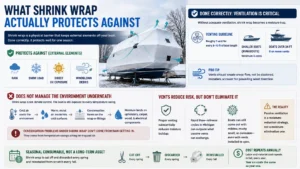
“Done correctly” matters here, because professional shrink wrap installation is a more technical process than it looks. Industry guidance is consistent on one point: shrink wrap without adequate ventilation isn’t a protective barrier, it’s a moisture trap. The standard recommendation is roughly one vent for every eight to ten feet of boat length, with a minimum of four vents on smaller runabouts and eight or more on boats over 34 feet, positioned to create cross-flow rather than clustered in one spot. Professional installers also account for prevailing wind direction and avoid the common mistake of assuming a tighter seal is always better, since a fully sealed wrap with no air exchange is precisely what creates the conditions for mold and mildew.
What shrink wrap, even installed to this standard, does not do is manage the environment underneath it. This is the point most comparisons skip, and it’s the one with the most practical consequence for a Michigan owner.
A shrink-wrapped boat sitting outside is still exposed to every temperature swing in the local forecast. The wrap doesn’t insulate its seals, with vents providing air exchange rather than climate control. When the air temperature outside drops and rises through a freeze-thaw cycle, the air trapped inside the wrap follows the same pattern. Warm, moist air condenses when it contacts a surface at or below its dew point the same reason a cold drink sweats on a humid day and inside a wrapped boat, that surface is often the underside of the wrap itself or any cold metal or glass fitting. That moisture then has somewhere to land: upholstery, carpet, wood trim, and electrical connections. This is a critical distinction: condensation problems under shrink wrap usually don’t come from rain getting in. They come from temperature swings acting on air that’s already trapped inside, condensing wherever it meets a cold enough surface.
Proper venting substantially reduces this risk. It does not eliminate it, particularly during the kind of rapid thaw-refreeze pattern Central Michigan sees multiple times per winter, when the volume and speed of temperature change can outpace what passive vents can exchange. Boats stored this way, even with vents installed to spec, can still come out of wrap in spring with a musty smell, mildew on vinyl seating, or corrosion starting on battery terminals and electrical connections not because the installation was done poorly, but because passive ventilation is fundamentally a moisture-reduction strategy, not a moisture-elimination one. That gap is the trade-off inherent to any barrier-based approach, regardless of how well it’s executed.
There’s a second consideration owners often miss: shrink wrap is a seasonal consumable, not a long-term asset. It’s cut off and discarded every spring and reinstalled from scratch every fall. That means the labor and material cost repeats annually, in full, for as long as the boat is owned. There’s no equity building in the investment. Year six costs the same as year one.
What Climate-Controlled Indoor Storage Protects Against
Climate-controlled indoor storage works on a different principle entirely. Instead of sealing the boat against the outside environment, it removes the boat from that environment and holds the surrounding air at a stable temperature range.
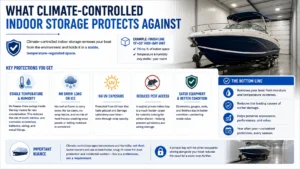
That distinction barrier versus environment is the core of this whole comparison. A private, climate-controlled bay like Finish Line’s 15×50 high-bay units 750 square feet of temperature-regulated indoor space, purpose-built rather than a converted warehouse bay keeps ambient temperature and humidity from swinging the way outdoor air does. Because the air inside the bay doesn’t cycle through repeated freeze-thaw swings, condensation has far less opportunity to form on interior surfaces in the first place. That reduces the conditions that lead to mold, mildew, and corrosion on batteries, wiring, and metal fittings.
Indoor storage also removes snow load and ice entirely from the equation. There’s no roof-and-frame system to fail under accumulated weight, no ice damming against a wrap seam, and no risk of a hard freeze cracking a wrap panel and letting moisture in unnoticed for weeks. UV exposure, which degrades gelcoat and upholstery over time even through a wrap’s opacity, is also a non-issue indoors.
Pest access is another factor worth naming directly, because it rarely comes up in comparisons but matters to anyone who’s opened a shrink-wrapped boat in spring to find rodent damage in upholstery or wiring. A sealed indoor bay is a materially harder target for rodents looking for winter shelter than an outdoor-stored, wrapped boat sitting near a tree line or field edge, a common setting in Montcalm County’s more rural storage locations.
One nuance worth being upfront about: climate control manages temperature and humidity, not dust. Some owners of boats stored indoors still prefer a breathable, snug-fit cover over the boat itself, mainly for dust and to protect gelcoat from incidental contact if the bay is shared or accessed by others. That’s a personal preference decision, not a protection requirement. A private bay with no other occupants storing alongside your boat reduces the need for it further.
Side-by-Side Comparison
| Factor | Shrink Wrap | Climate-Controlled Indoor Storage |
| Moisture/condensation risk | Moderate to high: trapped air still cycles with outside temperature | Low, stable ambient temperature limits condensation formation |
| Freeze-thaw stress | Boat still fully exposed to swings | Boat is removed from the swing entirely |
| Snow load / ice | Wrap frame must bear the load | Not a factor |
| UV exposure | Reduced but not eliminated | Eliminated |
| Rodent/pest access | Higher risk, especially in rural outdoor lots | Lower risk in a sealed private bay |
| Dust | Sealed off completely | Present unless a breathable cover is used |
| Mold/mildew risk | Elevated due to trapped condensation | Reduced due to stable humidity |
| Winter accessibility | Boat is sealed; checking on it means cutting into the wrap | 24/7 access to check on the boat anytime |
| Spring commissioning | Cutting off and disposing of wrap adds labor before launch prep begins | Boat is already accessible; commissioning starts immediately |
| Annual recurring cost | Full labor and material cost every single year | Monthly rental, scalable to the exact months needed |
| Resale condition | Variable, depends heavily on execution and that season’s weather | More consistently preserved interior and exterior condition |
Cost Over One Winter vs. Five Winters
A single-winter comparison tends to favor shrink wrap on price, and for some owners that’s a legitimate reason to choose it. But most boats aren’t owned for one winter. They’re owned for five, eight, sometimes fifteen years, and the economics look different once you extend the timeline.
Shrink wrap is a full-cost, no-equity expense every single season. Materials and labor are paid in full each fall, removed and thrown away each spring, and paid again the next fall with no reduction in cost as time goes on and no protection carried forward from one year to the next. Over five winters, an owner pays the full price five separate times for a product that offers zero long-term asset value.
Indoor storage works differently: it’s billed month-to-month, so the owner only pays for the months the boat is actually off the water. To put a real number on it, Finish Line’s 15×50 climate-controlled bays in Vestaburg rent for $450.00 per month with no long-term contract. Nationally, climate-controlled indoor boat storage tends to sit at the premium end of the market industry pricing generally runs $10 to $25 per foot per month for covered or indoor space, with private climate-controlled bays commonly landing in the $350-$500/month range depending on region and unit size. Finish Line’s rate falls within that expected range for a private, purpose-built bay of this size class, rather than at either extreme.
Over a typical six-to-seven month Michigan off-season, that works out to roughly $2,850–$3,325 in storage cost for the winter, paid only for the months actually used. Because it’s climate-controlled and consistent year over year, the protection quality doesn’t degrade with a bad install or a harsh winter the way a shrink wrap job can. The monthly rate buys the same environmental stability in year one as in year eight. Over a five-year ownership window, the real comparison isn’t just dollars spent, it’s dollars spent per unit of protection, and indoor storage’s consistency tends to hold its value better across seasons with unpredictable freeze-thaw severity, which in Central Michigan is most of them.
There’s also a cost most owners don’t put a number on until they’re facing it: repair costs from moisture damage, corrosion, or mildew remediation that show up after a rough winter under wrap. Reupholstering water-stained vinyl, replacing corroded electrical connections, or addressing a mildew smell that’s worked into carpet and cushions can, in a bad year, add real expense on top of whatever the wrap itself costs, an expense that a stable indoor environment is specifically designed to prevent.
| Category | Shrink Wrap (Michigan) | Indoor Climate Controlled Storage |
| Monthly Cost | N/A (one-time seasonal service) | $450/month (15 × 50 × 16 private bay) |
| Cost per Winter
(6–7 months) |
Approximately $150-$400, based on Michigan-reported $8-$19/ft pricing plus typical extras | $2,700–$3,150 ($450 × 6-7 months) |
| Cost Over 5 Winters | Approximately $750-$2,000+, paid in full each year with no residual value | $13,500–$15,750 |
Which Option Fits Different Boat Owners
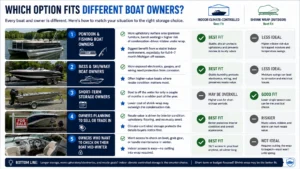
Pontoon and fishing boat owners on Coldwater Lake, Pine Lake, Lake Montcalm, and similar inland lakes boats with more upholstery surface area (pontoon furniture, bench seating) are more exposed to condensation-driven mildew risk under wrap. These owners tend to see the clearest benefit from a stable indoor environment, particularly if the boat is stored for the full six-to-seven month Michigan off-season rather than a shorter window.
Bass boat and ski/wake boat owners boats with more exposed electronics, gauges, and wiring benefit from the corrosion protection that comes with stable humidity. These are also often higher-value boats where resale condition carries more weight in the storage decision.
Owners storing for a single, shorter season if a boat is only off the water for a couple of months in a milder stretch of the calendar, shrink wrap’s lower single-season cost may reasonably outweigh the condensation risk, particularly for a boat with minimal upholstery and older electronics where preservation isn’t as high a priority.
Owners planning to sell or trade in within the next few years resale value is heavily influenced by interior condition: upholstery, flooring, and absence of a musty smell during a showing. Consistent climate-controlled storage tends to protect exactly the details a buyer notices first.
Owners who want to check on the boat mid-winter a wrapped boat requires cutting into the seal to inspect anything inside, which most owners simply don’t do until spring. A private, 24/7-accessible indoor bay lets an owner check on the boat, grab gear, or handle mid-winter maintenance without disturbing any seal or protection.
Common Mistakes Boat Owners Make With This Decision
Treating shrink wrap as full environmental protection: It’s a barrier against external elements, not a climate control system. Even with vents installed to industry spec, trapped condensation remains a real risk during rapid freeze-thaw swings; the installation quality changes the degree of risk, not whether the risk exists.
Assuming indoor storage means zero maintenance thinking: Climate control removes the biggest environmental risks, but batteries should still be disconnected or maintained per manufacturer guidance, and basic pre-storage prep still matters regardless of where the boat sits.
Comparing only single-season cost: As covered above, shrink wrap’s lower one-time price looks different once it’s multiplied across five or ten years of ownership with no residual value.
Underestimating Michigan’s freeze-thaw frequency: Owners moving from milder climates, or basing decisions on a friend’s experience in a different state, often underestimate how many freeze-thaw cycles Central Michigan actually sees in a typical winter and that number is the single biggest variable driving condensation risk under wrap.
Storing a boat outdoors near tree lines or fields without factoring in pest risk: This is a quiet but real cost. Rodent damage to upholstery and wiring is one of the more expensive spring surprises tied to outdoor storage.
FAQs
Is shrink wrap enough protection for a Michigan winter?
It depends on the boat, the length of storage, and how much upholstery and electronics exposure is involved. Shrink wrap protects well against external elements like snow and direct UV, but it doesn’t manage condensation caused by temperature swings, which is a significant risk factor during Central Michigan’s freeze-thaw season.
Do I still need shrink wrap if my boat is stored indoors?
Not for environmental protection, climate control handles that. Some owners still choose a breathable, snug-fit cover for dust protection, which is a personal preference rather than a necessity in a private bay.
Which option better protects resale value?
Consistent climate-controlled storage tends to better preserve the interior condition, upholstery, flooring, absence of musty odor that buyers evaluate most closely, particularly over multiple years of ownership.
Which costs less over several winters?
Shrink wrap has a lower single-season cost but repeats in full every year with no residual value. At Finish Line, a 15×50 climate-controlled bay runs $450.00/month, billed only for months using a rate that falls within the typical $350–$500/month national range for private, climate-controlled boat storage. Over a multi-year ownership window, that consistent monthly cost, combined with the moisture-related repair costs shrink wrap doesn’t fully prevent, tends to close the cost gap significantly or reverse it.
Does my boat need to be winterized differently depending on the storage method?
Basic winterization steps engine care, battery maintenance, fluid checks apply regardless of where the boat is stored. The storage method changes the environmental risk the boat faces afterward, not whether winterization itself is needed.
Is spring launch easier with one option over the other?
Boats coming out of indoor storage are typically ready to move immediately, since there’s no wrap to cut off and dispose of first. That’s one less step, and one less potential source of damage from careless wrap removal, standing between the boat and the water.
Why Climate-Controlled Indoor Storage Makes Sense for Many Central Michigan Boat Owners
Given the length of Michigan’s off-season and the frequency of freeze-thaw cycling in Montcalm County specifically, the environmental case for climate-controlled indoor storage is strong for most boats stored longer than a couple of months. Shrink wrap remains a reasonable choice for some owners and some boats aren’t being dismissed here. But for anyone storing a pontoon, fishing boat, bass boat, or ski boat through the full six-to-seven month window most Central Michigan owners face, the condensation and freeze-thaw risk under wrap is a real cost, even when it doesn’t show up until spring.
Finish Line RV & Boat Storage’s 15×50 private high-bay units in Vestaburg are built around this exact problem: 750 square feet of climate control that keeps ambient conditions stable through the freeze-thaw season, 24/7 keypad access and HD video monitoring if an owner wants to check on their boat mid-winter, and month-to-month rental at $450.00/month with no long-term contract, so storage cost lines up with actual months used rather than a flat seasonal commitment. For boat owners across Vestaburg, Stanton, Edmore, Lakeview, Howard City, and the surrounding Montcalm County lake communities, that combination addresses the specific risks this comparison has walked through not as a sales pitch, but as the direct result of what Michigan winters actually do to a stored boat.
Ready to Compare Your Options in Person?
If you’re still weighing shrink wrap against indoor storage, the details of your specific boat size, upholstery, storage duration, and how often you want access should drive the final call. Book a 15×50 high-bay unit online in under two minutes, or call 989-560-0047 if you want to talk through unit fit before your fall haul-out date arrives.


