
Month-to-Month vs. Long-Term Storage: Which Is Right for You?
At the end of October, something predictable happens across Montcalm County. Campgrounds close. Lake access declines. Pontoons come off the water. Travel trailers stop moving. The recreational season that defines Central Michigan summers camping along the Flat River corridor, weekends on Six Lakes, fishing trips out of Howard City and Lakeview ends within a few weeks, and thousands of RVs and boats that were in constant use are suddenly sitting unused.
What owners do with those vehicles in the next sixty days sets the condition they’ll be in when May arrives.
The storage decision has two layers:
- Which unit type protects your vehicle through a Central Michigan winter
- Which rental term fits your actual ownership pattern.
These are different questions with different answers. This guide works through both starting with how Montcalm County’s ownership and seasonal patterns shape the decision, and ending with the framework that makes it clear.
The Ownership Lifecycle That Drives the Storage Decision
Storage is one stage in a longer cycle most owners don’t think about as a system. Understanding the full cycle explains why the wrong rental term or the wrong unit type costs more than the monthly difference suggests.
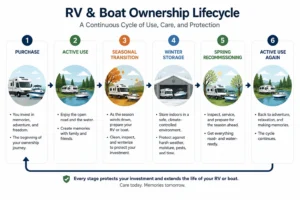
Each transition point is a preservation decision. The active season is obvious vehicles get used, minor maintenance gets done, problems get noticed quickly. The transition points at both ends of winter are where most preventable damage happens.A winterized vehicle and a stored vehicle emerge from spring in fundamentally different condition, which starts with preparation, not luck.
Fall transition: Vehicles come out of use rapidly in Montcalm County when campgrounds close and water temperatures drop. Owners who store quickly and properly protect the vehicle through winter. One pattern that repeats itself every fall: owners who leave vehicles exposed through October and November waiting to “figure out storage” expose them to the first freeze-thaw cycles before protection is in place.The most costly RV storage failures follow from delays like this one, and they’re all preventable. By the time they arrange indoor storage, the damage has already started.
Spring recommissioning: A vehicle that spent winter in climate-controlled indoor storage arrives at spring in the condition it left fall. A vehicle that spent winter exposed to freeze-thaw, moisture, and temperature swings arrives at spring with problems sometimes visible, sometimes hidden inside wall cavities and under subfloor panels.
The rental term decision influences the cost structure. The unit type decision influences the vehicle’s condition. Both matter, but they’re independent choices.
How Central Michigan’s Seasonal Pattern Shapes the Storage Decision
Unlike warmer regions where RVs and boats stay in use most of the year, owners across Vestaburg and Montcalm County typically enjoy a five- to six-month recreation season followed by an equally long off-season.
That seasonal imbalance changes the storage equation. If your RV or boat spends only the winter months in storage, paying month-to-month often results in a lower total cost than committing to a year-long agreement, even if the monthly rate is higher. For owners who store vehicles most of the year or need guaranteed access to a premium unit, long-term storage becomes the stronger value.
Seasonality doesn’t just affect cost it also determines how much protection your vehicle needs during months of inactivity.
Why Winter Storage Quality Matters in Central Michigan
A Central Michigan winter exposes stored RVs and boats to repeated freeze-thaw cycles, condensation, and prolonged inactivity. Together, these conditions can accelerate roof seal wear, encourage interior moisture and mold, discharge batteries, and increase the risk of plumbing or fuel system issues if the vehicle isn’t properly prepared.
For both RVs and boats, indoor climate-controlled storage helps maintain a stable environment that minimizes these risks while reducing the amount of spring repair and recommissioning required.
The key point isn’t simply that winter is harsh, it’s that six months of inactivity magnifies the long-term cost of poor storage decisions. A single season of preventable damage can easily outweigh the savings of choosing a cheaper storage option.
That’s why the storage term and the storage environment should be considered together. Month-to-month or long-term determines how you pay; indoor climate-controlled storage determines how well your investment is protected.
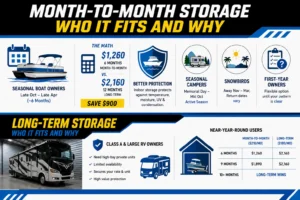
Month-to-Month Storage: Who It Fits and Why
Pontoon and Fishing Boat Owners in Lake Communities
The recreational boating season on Montcalm County lakes follows a tight calendar. Memorial Day to Labor Day is peak use. September extends for fishing and smaller gatherings. By mid-October, water temperatures have dropped enough that most recreational use has ended and haul-out begins.
A pontoon owner on Six Lakes or a fishing boat owner accessing Tamarack Lake or the Muskegon River headwaters through the Lakeview or Coral areas faces a storage window of roughly late October through late April six months. Month-to-month indoor storage for that period costs more per month than a long-term rate but covers only the actual off-season rather than twelve months.
One decision boat owners in this area frequently weigh is shrink wrap versus indoor storage. Shrink wrap is commonly used for boats left outdoors and costs $15 to $25 per foot of boat length depending on who applies it; a 22-foot pontoon runs $330 to $550 just for the wrap, applied annually. It protects against snow load and some moisture but doesn’t address temperature, condensation inside the wrap, or UV on hardware and canvas. Indoor storage eliminates all of these variables and, when weighed against annual shrink wrap costs over several years, is often competitive in total cost while offering substantially better protection.
The math is straightforward: if climate-controlled indoor storage runs $210/month on a rolling basis and $180/month on a 12-month contract, six months of month-to-month totals $1,260 versus $2,160 for the full-year commitment. Month-to-month saves $900 in total cost despite its higher per-month rate.
Seasonal Campers and Travel Trailer Owners
Families and couples in the Stanton, Sheridan, Carson City, and Edmore areas who use travel trailers or fifth wheels for weekend camping run a similar seasonal pattern. Memorial Day through mid-October is the active window; the vehicle sits from November through April.If you own a fifth wheel, specific storage preparation steps apply to protect it through the six-month off-season.
For these owners, the storage decision connects directly to campground operating seasons when the campgrounds close, the storage need begins. Montcalm County’s campgrounds along the Flat River and surrounding recreation areas typically close by mid-October. The storage window follows.
Month-to-month storage lets these owners pay for the five to six months their vehicle is inactive without carrying twelve months of fees.
Snowbirds Who Leave Michigan in Winter
The snowbird dynamic in Montcalm County creates a storage pattern that’s often misunderstood. Snowbirds don’t need storage because they’re in Michigan for the winter they need storage because they’re not.
A common scenario: a retired couple from the Vestaburg or Blanchard area spends November through March in Arizona or Florida. They drive a car south or take a second smaller vehicle. Their primary Class C motorhome or fifth wheel stays behind in Michigan and needs protected indoor storage through exactly the period that presents the most risk.
Because snowbird return dates vary, an early spring or a family situation can pull them back in March instead of April month-to-month storage aligns better with uncertain timelines than a 12-month contract that charges through May or June regardless.
Owners with Shifting Schedules or First-Year Storage Needs
Owners storing a vehicle for the first time often don’t yet know how their pattern will settle. How many months will they actually need? Will their camping season expand? Will they travel more or less next year?
Starting month-to-month in the first season removes the financial risk of committing to a term before the actual need is established.Transitioning to a long-term rate in year two once the pattern is clear captures the savings without the risk of overpaying for unused months.
Long-Term Storage: Who It Fits and Why
Class A Motorhome and Large RV Owners
Class A diesel pushers, large Class C coaches, and extended fifth wheels present two connected problems that make long-term storage the better choice for most owners in this category.
First, they require a specific unit type, a high-bay private bay with adequate clearance and width for vehicles that can reach 40 feet in length and 13 feet in height. These units are not interchangeable with standard storage bays, and at any given facility the number of high-bay units is finite.
Second, demand for these units in Montcalm County follows the same October peak that drives all indoor storage demand but the stakes are higher because there are fewer units and the vehicles being protected are often worth $150,000 to $400,000. A Class A owner who arrives at Finish Line in mid-November looking for a private high-bay may find them already committed to tenants who reserved earlier.
A long-term agreement secures both the rate and the unit. The vehicle is guaranteed a protected space through the winter and into spring without competing against October demand.
Near-Year-Round Storage Users
Some owners in the Pierson, Fenwick, and Sidney areas have rural properties but lack covered enclosed storage that can accommodate a 36-foot fifth wheel or a 24-foot pontoon on a trailer. For these owners, the vehicle lives in storage longer not just through winter, but through periods in summer when it’s not in use and home storage isn’t an option.
When the actual storage window extends to nine months or longer, the long-term rate becomes the more cost-effective choice. At nine months: month-to-month at $210 × 9 = $1,890 versus long-term at $180 × 12 = $2,160. The long-term annual contract is still higher in total cost at nine months, but the per-month savings and guaranteed unit availability start closing the gap. By ten or eleven months, long-term clearly wins.
Owners Who Prioritize Vehicle Preservation Over Flexibility
Some RV and boat owners make the calculation that year-round indoor storage is worth the annual cost because of what it prevents during the use season, not just winter. A boat stored on a trailer at home between lake trips is exposed to UV, bird damage, and surface weathering. Gel coat oxidation from summer UV exposure is preventable but not reversible. A year-round climate-controlled storage agreement eliminates this exposure entirely, and a long-term rate reduces the monthly cost of that decision.
October Demand Peak: Why Timing Matters in This Market
Across Montcalm County, indoor storage demand follows a narrow, predictable window. By late September, inquiries for premium indoor units begins increasing noticeably. Most owners recognize they need storage when temperatures drop typically in September or October and begin making arrangements in that same window. The overlap between “I need to arrange storage” and “so does everyone else” creates a demand peak that affects what’s available.
Premium indoor storage units, specifically private high-bay bays that accommodate Class A motorhomes, large fifth wheels, and extended pontoon trailers are the first to commit. By early November, quality units at a well-run facility are often no longer available for new month-to-month tenants.
Owners who establish storage early ideally before mid-October have access to the full inventory of unit types. Owners who wait until November navigate a tighter selection, sometimes accepting a less protective unit type because the preferred option is no longer available.
This dynamic explains why long-term agreements hold value beyond their per-month discount: they lock in the unit before the October compression. Month-to-month tenants at Finish Line RV & Boat Storage can still secure excellent units if they act early. The advantage of long-term is that the reservation doesn’t depend on timing.
Rental Term Is One Decision. Unit Type Is Another.
Owners sometimes assume that month-to-month storage means basic or outdoor storage that flexibility comes at the cost of protection. It doesn’t. Rental term and unit type are separate decisions.
A snowbird who needs five months of premium protection can rent month-to-month in a private climate-controlled bay at Finish Line. A year-round storage user with a consistent pattern can commit to a long-term agreement in the same unit. The term determines cost structure and flexibility; the unit type determines what happens to the vehicle over winter.
For RVs and boats stored through Central Michigan’s freeze-thaw season, the unit type that addresses the risks described above seal stress, condensation, battery degradation, plumbing exposure is indoor climate-controlled storage. Private high-bay units at Finish Line accommodate large vehicles that exceed the dimensions of standard storage bays.
Choosing a lower-cost outdoor unit to preserve budget, then absorbing spring repair costs, often inverts the intended savings.
Spring Recommissioning Connection
Storage ends when owners retrieve their vehicles in April or May, and what they find reflects how the vehicle spent winter. This connection between winter storage quality and spring readiness is one that owners who’ve experienced a storage failure understand viscerally and others underestimate.
A vehicle retrieved from climate-controlled indoor storage in late April typically requires minimal recommissioning: a battery charge, a basic systems check, and it’s ready for the camping or boating season. A vehicle retrieved from outdoor or inadequately protected storage may present cracked roof seals, moisture damage in wall panels, failed batteries, mold in the interior, or a split water line that requires repair before the vehicle is safe to use.
For boats, the most common issues discovered in spring after outdoor or inadequately protected storage are mold in upholstered seating, corroded electrical connections from condensation exposure, and a starting battery that won’t hold a charge. The most common issues after a well-protected indoor winter are essentially no fresh charge, a quick inspection, and the boat is ready for launch. The difference in spring preparation time alone, a few hours versus potentially weeks of repair scheduling, has real value for owners in lake communities where the May fishing opener has a fixed date.
The cost and delay of spring repairs arriving in the exact window when owners want their vehicles back on the road or water is the final relationship in the storage decision chain. Indoor climate-controlled storage at a facility like Finish Line doesn’t just protect the vehicle through winter; it shortens and simplifies the spring recommissioning that follows.
Decision Framework
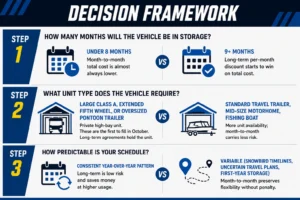
Step 1: How many months will the vehicle be in storage?
Under 8 months → month-to-month total cost is almost always lower.
9+ months → long-term per-month discount starts to win on total cost.
Step 2: What unit type does the vehicle require?
Large Class A, extended fifth wheel, or oversized pontoon trailer → private high-bay unit.
These are the first to fill in October. Long-term agreements hold the unit.
Standard travel trailer, mid-size motorhome, fishing boat → more unit availability; month-to-month carries less risk.
Step 3: How predictable is your schedule?
Consistent year-over-year pattern → long-term is low risk and saves money at higher usage. Variable (snowbird timelines, uncertain travel plans, first-year storage) → month-to-month preserves flexibility without penalty.
Most seasonal campers and boaters across Lakeview, Howard City, Six Lakes, Stanton, and the lake communities of Montcalm County land in the month-to-month category. Most year-round users, Class A owners, and owners of large vehicles who need a guaranteed private bay come out ahead with long-term agreements.
Seasonal Storage Timeline for Montcalm County Owners
| Month | What’s Happening | Storage Action |
| August–September | Camping and boating season still active | Begin researching storage options; premium units start filling |
| Early October | Season winding down; campgrounds announcing closures | Secure indoor unit before October peak demand |
| Mid–Late October | Campgrounds closed; haul-out begins on lakes | Bring vehicle in; month-to-month or long-term begins |
| November–March | Vehicle in winter storage | Periodic battery maintenance if shore power is available; minimal visits |
| April | Temperatures rising; snowbirds returning | Retrieve vehicle; recommission for season |
| May | Camping and boating season opens | Vehicle in active use |
Owners who follow this timeline arranging storage in September or early October rather than waiting for a cold snap consistently secure better unit options and avoid the rush that compresses availability each fall.
FAQs
Is shrink wrap a reasonable alternative to indoor boat storage?
Shrink wrap protects against snow load and weather but doesn’t address temperature, condensation inside the wrap, UV on hardware and canvas, or battery management. Annual shrink wrap application costs $15 to $25 per linear foot, which accumulates over multiple seasons. For owners comparing the two options over a three-to-five year horizon, indoor storage often comes out competitive in total cost while providing substantially more complete protection.
Is month-to-month storage more expensive?
Per month, yes. In total cost, it depends on how long you actually need the unit. For a typical Central Michigan off-season of five to six months, month-to-month often costs $700–$900 less in total than a 12-month contract, despite the higher monthly rate.
Can I rent storage only for winter, say, November through April?
Yes. Month-to-month storage is specifically suited to this. You pay from when your vehicle goes in until you retrieve it in spring, without carrying costs for the months it’s on the water or at a campsite.
What unit type best protects a vehicle through a Michigan winter?
Indoor climate-controlled storage in a private bay. It prevents the specific damage patterns seal stress from freeze-thaw cycling, condensation-driven mold, battery deep-discharge, and plumbing freeze that accumulate across a Montcalm County winter.
When do premium units typically fill in this area?
The demand peak in Montcalm County is October. Private high-bay and climate-controlled units at quality facilities are often committed by early November. Owners who arrange storage in September or early October have access to the full inventory.
Should I store year-round even when I’m using my RV in summer?
Some owners with high-value vehicles do. Year-round indoor storage prevents UV degradation, bird and weather damage, and security risk during the use season, and a long-term rate reduces the monthly cost. Whether it makes sense depends on the vehicle’s value and your home storage situation.
Can I access my vehicle anytime, or only during business hours?
Finish Line RV & Boat Storage provides 24/7 access regardless of rental term. Owners who perform maintenance in the bay, charge batteries periodically through winter, or need to retrieve gear between trips aren’t restricted to a business schedule.
Can I switch from month-to-month to a long-term contract?
Generally yes, subject to unit availability. Starting month-to-month in your first storage season and transitioning to long-term once your annual pattern is established is a practical approach for owners who aren’t yet certain how many months they’ll need each year.
Does long-term storage actually save money if I exit early?
It depends on the facility’s early exit policy. If the contract requires a minimum number of months or charges a fee for early departure, the per-month savings can disappear. Review the exit terms before signing.
Putting It Together
The storage decision in Montcalm County is shaped by a specific set of conditions that don’t generalize to other markets: a five-to-six month off-season that concentrates storage demand in October, a freeze-thaw climate that creates specific damage risks for vehicles stored through winter, and an ownership population that skews toward seasonal use rather than year-round recreation.
Month-to-month storage fits most of that population seasonal boaters near Six Lakes and Lakeview, camping families from Stanton and Sheridan, snowbirds who need a winter home for their vehicle while they’re in warmer states. It aligns cost to the actual off-season, preserves flexibility, and for most vehicles in most Montcalm County storage windows, it’s the lower total cost.
Long-term agreements fit the owners for whom losing a specific unit type is a real risk Class A owners, large fifth wheel owners, and anyone whose storage window runs toward nine or ten months and owners who want to remove the October availability question entirely.
Finish Line RV & Boat Storage offers both rental structures across climate-controlled indoor units and private high-bay bays designed for the large RVs and boats that define recreational vehicle ownership in Central Michigan. View available units and book online or contact the team to match your vehicle, your seasonal schedule, and the right unit to the term structure that fits.


