

Class A Motorhome Storage Requirements
Storing a Class A motorhome isn’t the same problem as storing a car or a travel trailer. These coaches run 30 to 45 feet long, stand 12 to 13.5 feet tall, and often carry a value well into six figures. Finding “a large parking space” solves almost none of the actual requirements. What matters is door clearance, interior height, climate stability, moisture control, and how the coach is prepped before it sits for months at a time.
We store Class A motorhomes year-round in Vestaburg, Michigan, which means we deal with the two things that do the most damage to a big coach: humidity swings and freeze-thaw cycles. This guide walks through the real requirements, the measurements, the prep work, and the conditions that separate a motorhome that comes out of storage ready to drive from one that needs bodywork, new tires, or a mold remediation before its first spring trip.
What Counts as a Class A Motorhome?
A Class A motorhome is a bus-style RV built on a heavy-duty chassis, typically 29 to 45 feet long, 8.5 feet wide (before mirrors and slides), and 12 to 13.5 feet tall including roof-mounted AC units and antennas. Gas models tend to run shorter and lighter; diesel pushers are usually the longest and heaviest, often exceeding 20,000 pounds fully loaded.
The size and complexity of a Class A is exactly why storage requirements are stricter than they are for a travel trailer or a truck camper. These coaches have full residential systems built in: household plumbing, holding tanks, house batteries, generators, slide-out rooms, and in many cases hardwood cabinetry, tile flooring, and leather furniture. Every one of those systems reacts differently to heat, cold, and humidity, which is the core reason storage conditions matter as much as storage space.
Slide-outs deserve their own mention here. Most Class A coaches have one to four slide-out rooms that extend the living space by a foot or two on each side. Whether those slides stay in or out during storage changes both the footprint you need and the risk to the seals more on that below.
Storage Space Requirements for Class A Motorhomes
A Class A motorhome typically needs a storage space at least 45–50 feet long, 12 feet wide, and with a door clearance of 13.5–14 feet or more to safely accommodate the coach, mirrors, and roof-mounted equipment. Anyone shopping for storage should measure their actual coach bumper to bumper, ground to the tallest roof accessory, and mirror to mirror rather than relying on the RV’s advertised model length.
Here’s what to measure and why it matters:
| Measurement | Why It Matters |
| Overall length | Bumper to bumper, including ladders, spare tire carriers, and hitch-mounted racks. Model length on the spec sheet often excludes these. |
| Height at tallest point | Ground to the top of the AC unit, satellite dome, or roof vent not the “wall height” listed by the manufacturer. |
| Width with mirrors extended | Add 12–18 inches per side for towing mirrors if they don’t fold in. |
| Width with slides extended | If slides stay out, add the slide-out depth to the coach’s base width. |
| Turning radius | The space needed to back the coach into the bay, not just the parked footprint. |
| Awning clearance | Awning arms and mounting hardware add a few inches of width that’s easy to miss. |
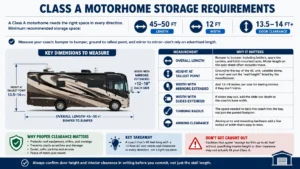
A coach that’s 45 feet long with a 13-foot AC unit needs real clearance in every direction, not a tight squeeze. Facilities that quote “storage for RVs up to 40 feet” without specifying interior height or door clearance are leaving out the two measurements that actually determine whether a Class A fits. Always confirm door height and interior clearance in writing before you commit, not just the stall length.
Why Indoor Storage Matters More for Large Class A Coaches
Indoor storage protects a Class A motorhome from the specific damage sources outdoor storage can’t prevent: UV degradation of the roof membrane, freeze-thaw cracking, snow load on slide toppers, and long-term paint oxidation. The larger the coach, the more surface area is exposed to weather, and the more expensive that exposure becomes to repair.
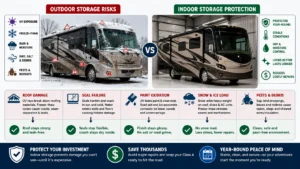
A few things we see repeatedly with coaches that spent a season outdoors:
Roof damage: Most Class A roofs are TPO, EPDM rubber, or fiberglass, and all three degrade under constant UV exposure. Rubber roofs especially are prone to seam separation and cracking after repeated freeze-thaw cycles water gets into a pinhole seam, freezes, expands, and turns a small issue into a full roof reseal.
Seal failure: Slide-out seals, window seals, and roof vent seals rely on rubber and foam gaskets that harden and crack in direct sun and cold. Once a seal fails, water finds its way into wall cavities and subfloor, and that damage is often invisible until it’s extensive.
Paint and clear coat oxidation: UV exposure fades gel coat and clear coat finishes, and Michigan winters add road salt and ice to the mix if a coach is stored anywhere near a plowed lot. Indoor storage removes UV exposure entirely and keeps salt spray away from the undercarriage and lower panels.
Snow load and ice: A few inches of wet snow sitting on a slide-out topper or roof AC shroud adds real weight, and repeated freeze-thaw cycles on that snow load stress roof seams and slide mechanisms.
Pests and debris: Outdoor storage under or near trees means sap, bird droppings, and rodents looking for a warm, dry place to nest which for a rodent, an idle motorhome is exactly that.
None of this is theoretical. It’s the same list of repairs we hear about from customers who stored outdoors in previous years before switching to an indoor bay.
Climate-Controlled Storage vs. Standard Indoor Storage
Climate-controlled storage keeps temperature and humidity within a stable range, which prevents condensation inside the coach standard indoor storage (a roof and walls with no climate regulation) blocks precipitation and UV but doesn’t stop humidity swings that cause mold, mildew, and interior damage. For a Class A with wood cabinetry, upholstered furniture, and built-in electronics, that distinction is significant.
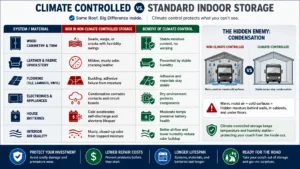
Here’s where the difference actually shows up:
| System / Material | Risk in Non-Climate-Controlled Storage | Benefit of Climate Control |
| Wood cabinetry & trim | Swells, warps, or cracks with humidity swings | Stable moisture content, no warping |
| Leather & fabric upholstery | Mildew, musty odor, cracking leather | Prevented by stable humidity |
| Flooring (tile, laminate, vinyl) | Buckling, adhesive failure from moisture | Adhesive and materials stay stable |
| Electronics & appliances | Condensation corrodes contacts and circuit boards | Dry environment protects components |
| House batteries | Cold accelerates self-discharge and shortens lifespan | Moderate temps preserve battery health |
| Interior air quality | Musty, closed-up odor from trapped moisture | Better airflow and lower humidity reduce odor buildup |
Condensation is the quiet killer in RV storage. Warm, moist air meeting cold metal or glass surfaces inside an unheated building creates the same moisture problem as leaving a window cracked in the rain except it happens invisibly, inside cabinets and behind panels, over weeks and months. Climate-controlled storage keeps that temperature differential from happening in the first place.
Preparing a Class A Motorhome Before Storage
Good storage conditions only solve half the problem. The other half is how the coach goes into storage. This is the rv storage checklist we recommend to every customer storing a Class A for winter or any stretch longer than a few weeks.
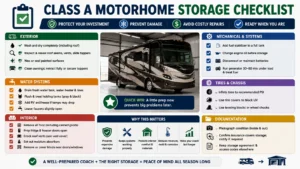
Exterior
- Wash and dry the entire coach, including the roof, before storage dirt and sap left on the finish etches into paint and rubber over time
- Inspect and re-seal roof seams, vents, and slide toppers if there’s any sign of cracking
- Apply a coat of wax or polymer sealant to painted surfaces for added UV and moisture protection
- Check and clean awnings, then retract fully or ensure toppers are properly seated
Mechanical & Systems
- Add fuel stabilizer to a full tank to prevent ethanol separation and fuel degradation
- Change the engine oil before storage used oil holds contaminants that can corrode internal engine components over months of sitting
- Disconnect or maintain house and chassis batteries with a trickle charger or battery maintainer
- Run the generator under load for 30-60 minutes before storage, then treat its fuel system the same as the main tank
Water Systems
- Drain fresh water tanks, water heater, and all lines
- Flush and treat holding tanks (gray and black) before storage
- Add RV antifreeze to the plumbing system if storage temperatures could drop below freezing, even in a climate-controlled bay, as a backup precaution
- Leave faucets in a slightly open position to relieve any residual pressure
Tires & Chassis
- Inflate tires to the manufacturer’s recommended PSI underinflated tires develop flat spots faster during long idle periods
- Consider tire covers to block UV exposure even in indoor storage, especially near windows or open bay doors
- Use leveling blocks or wheel chocks to reduce prolonged pressure points if the coach won’t move for months
Interior
- Remove all food, including canned goods temperature swings and pests both target stored food first
- Prop refrigerator and freezer doors open to prevent mildew
- Crack roof vents slightly (with a vent cover) to allow airflow if not fully climate-controlled
- Set out moisture absorbers in bathrooms, closets, and under sinks
- Remove or cover window blinds from direct light if parked near bay doors
Documentation
- Photograph the coach’s condition before storage, inside and out
- Confirm insurance coverage applies to the coach while in storage and note whether the policy requires notification of a storage location
- Keep a copy of the storage agreement and access codes somewhere other than inside the coach
Common Storage Mistakes That Cause Expensive Damage
Most of the expensive repairs we hear about trace back to a short list of avoidable mistakes:
- Underestimating height clearance showing up with a 13’6″ coach at a facility with a 12-foot door
- Skipping winterization because the storage is “indoor” indoor doesn’t guarantee freeze protection unless it’s specifically climate-controlled
- Leaving tires at road pressure for months, which leads to flat-spotting that shows up as a vibration at highway speed the following season
- Disconnecting batteries without maintaining them, leading to a dead house battery bank by spring
- Ignoring small roof leaks that seemed minor going into storage and become soft subfloor by the time the coach comes out
- Leaving food onboard, which is the single most common cause of rodent problems in stored RVs
- Not inspecting slide-out seals before extended storage, especially if slides are left extended
- Parking under trees where sap, debris, and bird droppings accumulate on the roof over an entire season
- Skipping a pre-storage walkthrough, which means small issues go unnoticed until the coach is pulled out for a trip
Questions to Ask Before Renting Class A Motorhome Storage
Before signing a storage agreement, get clear answers to these questions:
- What is the exact door clearance height, and what is the interior clearance height?
- Is the unit climate-controlled, or just covered/enclosed?
- What are the unit’s interior length and width dimensions?
- Is it a private bay, or a shared warehouse space with other RVs?
- Is access available 24/7, or only during limited office hours?
- Is the rental month-to-month, or does it require a long-term contract?
- What security measures are in place — video monitoring, gated access, individual access codes?
- Does the facility require proof of insurance, and does their policy cover the building or only their liability?
A facility that can answer all of these clearly and specifically — not with a “we can probably fit it” — is one that actually understands large RV storage.
How Finish Line RV & Boat Storage Meets Class A Motorhome Storage Requirements
Finish Line RV & Boat Storage in Vestaburg, Michigan was built with exactly these requirements in mind. Each unit is a private 15×50 indoor bay with 16 feet of interior clearance enough room for the height of a Class A motorhome, its roof-mounted AC units, and antennas, without the guesswork that comes with a facility that only lists a stall length.
The bays are climate-controlled, which addresses the humidity and condensation risks that standard covered storage doesn’t solve protecting wood cabinetry, upholstery, flooring, and onboard electronics through Michigan’s freeze-thaw winters. Because each unit is a private bay rather than a shared warehouse, coaches aren’t sharing space with other vehicles, which reduces the risk of accidental contact during move-in or move-out.
Rentals are month-to-month with no long-term contract, which fits how most Class A owners actually use storage seasonally, from fall layup through spring launch, without paying for a year-round lease. Access is available 24/7, so pulling the coach out for an unexpected trip, or getting in to run the generator or check on batteries mid-winter, doesn’t require coordinating with office hours.
The facility is located in Vestaburg, in the heart of Montcalm County, serving RV owners throughout mid-Michigan who need indoor, climate-controlled storage that’s actually sized and built for a Class A motorhome rather than adapted from a general-purpose storage unit.
People Also Ask
How big of a storage unit does a Class A motorhome need?
Most Class A motorhomes need a unit at least 45–50 feet long with 13.5–16 feet of clearance to account for roof-mounted AC units, antennas, and mirrors. Always measure your specific coach rather than relying on its listed model length.
Can a Class A RV be stored indoors?
Yes, and indoor storage is strongly recommended for Class A coaches given their size, value, and the amount of exposed surface area (roof, seals, paint) vulnerable to UV and weather damage.
Is climate-controlled storage worth it?
For a Class A with wood cabinetry, upholstery, electronics, and holding tanks, climate control is worth it; it prevents the humidity swings that cause condensation, mold, and material degradation that standard covered storage doesn’t address.
How tall is a Class A motorhome?
Most Class A motorhomes stand 12 to 13.5 feet tall including roof-mounted air conditioners and antennas, though some diesel pushers with raised roofs can be taller. Always measure your coach’s actual height rather than assuming based on its class.
Should I winterize before indoor storage?
Yes, even in climate-controlled storage. Winterizing protects the plumbing system as a backup in case of any temperature drop, and prevents fuel and battery issues that have nothing to do with the storage environment itself.
Can slide-outs stay extended?
It depends on available space and manufacturer guidance. Retracting slides is generally safer for the seals during long-term storage, but if a facility has the room and the seals are in good condition, extended slides can be fine for shorter stays. Check the coach’s owner’s manual for manufacturer-specific guidance.
How long can a Class A motorhome stay in storage?
A properly prepared Class A motorhome can stay in storage indefinitely with correct climate conditions and periodic maintenance checks batteries, tires, and fluids still need attention every few months, even in ideal storage.
What is the best way to store a luxury motorhome?
The best approach combines private indoor climate-controlled storage with thorough pre-storage preparation: full winterization, tire and battery maintenance, and a clean, sealed exterior treating the storage period as part of the coach’s maintenance schedule, not a pause from it.
FAQs
Does a Class A motorhome need to be winterized if it’s stored in a heated building?
If the building maintains temperatures reliably above freezing, full winterization may not be strictly necessary, but most owners still winterize as insurance against equipment failure or a power outage. It’s a low-cost precaution against a high-cost repair.
What happens if I don’t run my generator during storage?
Generators that sit unused for months can develop stale fuel issues and carbureted components can gum up. Running the generator under load before storage, and periodically during long storage periods, keeps it ready to start when needed.
Do I need to remove my RV’s batteries for storage?
Not necessarily. Batteries can often stay in the coach if they’re maintained with a trickle charger or battery maintainer. Fully disconnecting without any maintenance plan usually results in a dead battery bank by spring.
Will my tires need to be replaced after a season in storage?
Not if they’re properly inflated and, ideally, the coach is moved periodically to redistribute weight. Tires left at low pressure for months are far more likely to develop flat spots that require replacement.
Is a covered carport sufficient, or does a Class A need a fully enclosed unit?
A carport blocks precipitation and direct sun but doesn’t protect against wind-driven rain, temperature swings, humidity, or pests the way a fully enclosed, climate-controlled bay does. For a coach of this value, enclosed storage is the safer standard.
How much clearance do I actually need above my RV’s height?
A few inches of buffer above your coach’s tallest point is reasonable, but more matters more for maneuvering than for parking you need room to back in without clipping a doorframe with your AC unit or antenna.
Can I store a Class A motorhome with slides extended to save time on move-in and move-out?
It’s possible in a large enough bay, but extended slides expose more seal surface and take up more width. Retracting slides for long-term storage is generally the lower-risk choice.
What’s the difference between “indoor storage” and “climate-controlled storage” in practice?
Indoor storage means the coach is under a roof and inside walls, protected from precipitation and direct sun. Climate-controlled storage adds active temperature and humidity regulation, which is what actually prevents condensation and the interior damage that comes with it.
How often should I check on my motorhome during long-term storage?
Checking every 4–6 weeks to run the engine and generator briefly, check tire pressure, and glance over the batteries is a reasonable interval for most owners, more frequently if you’re new to long-term storage or storing through an unusually harsh winter.
Does storage location affect my RV insurance?
It can. Some insurance policies ask where a vehicle is primarily stored and may adjust coverage or premiums accordingly. Check with your insurer before storage season and keep documentation of your storage agreement on hand.
_____________________________________________________________________________________________
A Class A motorhome is often the most expensive vehicle in the driveway, and it deserves storage that matches that investment not just a large parking space. The dimensions matter, the climate conditions matter, and the prep work before the coach goes into storage matters just as much as where it sits for the winter. Done right, proper storage protects the coach’s resale value, its interior, its mechanical systems, and its appearance for years of use to come.
If you’re evaluating storage for a Class A motorhome in mid-Michigan, Finish Line RV & Boat Storage in Vestaburg offers private 15×50 climate-controlled bays with 16-foot clearance, month-to-month rentals, and 24/7 access — check current availability or contact us to confirm your coach’s fit before you book.


